Ocean and consciousness
Healing through frecuencies and the magic og cetaceans
An exploration of how cetaceans perceive their world through sound, echolocation and other extraordinary senses. Blending science with personal reflection, this article considers the transformative power of encountering whales and dolphins while emphasizing respectful, ethical observation in the wild.
Published September 2026
6 minutes
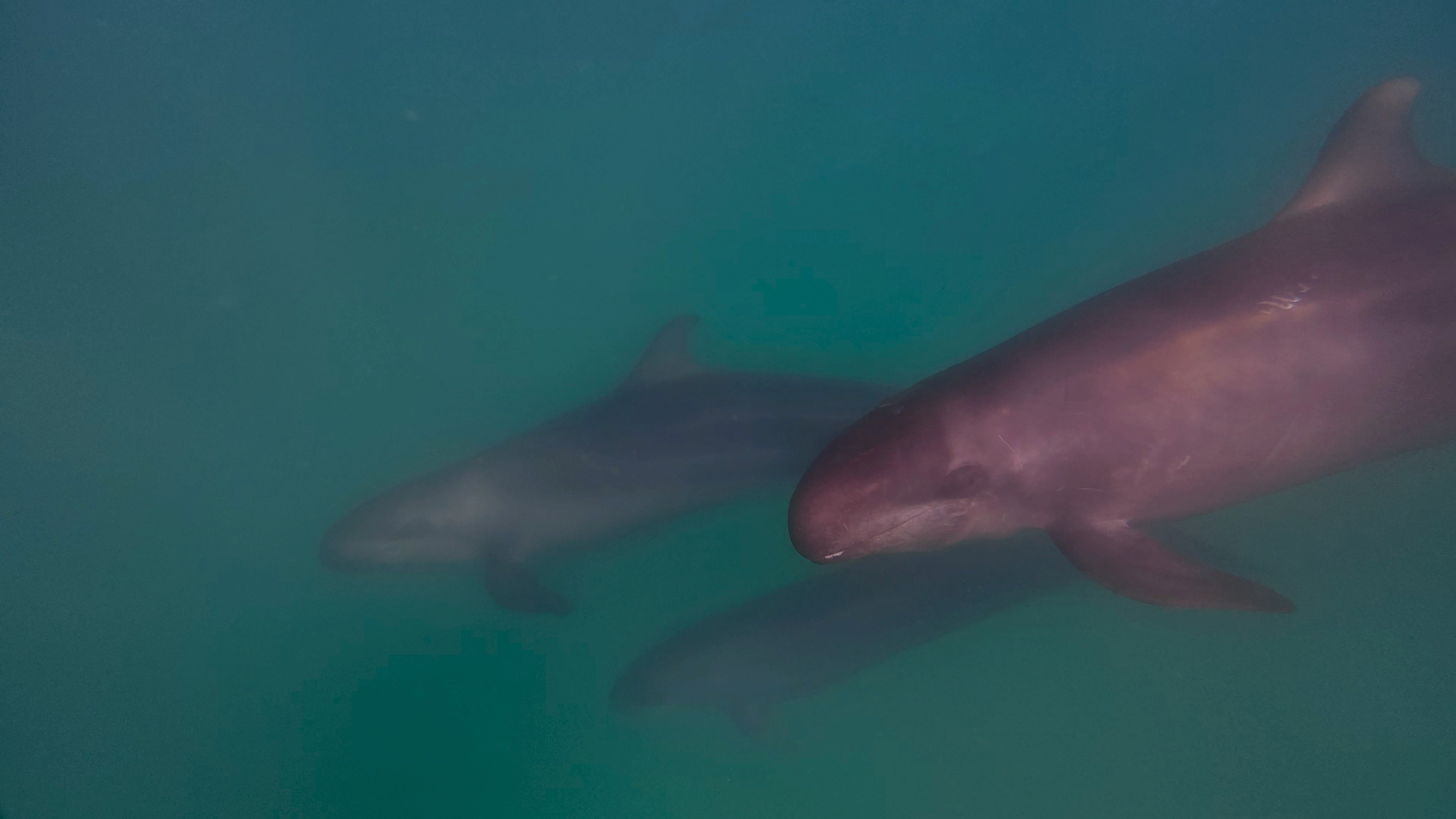
Healing Through Frequencies and the Magic of Cetaceans
We are living through a time of profound transformation. From an astrological perspective, the beginning of the Age of Aquarius represents the awakening of a visionary consciousness: an opening towards everything we cannot see but may, in some way, perceive.
Consider the internet for a moment. Today, sending images, voices and messages from one side of the planet to the other seems completely normal. Information travels through electrical signals, electromagnetic waves, submarine cables and satellites. Yet only a few decades ago, this possibility would have sounded like science fiction.
If we have learned to accept that an invisible reality can carry information, why is it so difficult to imagine that other forms of perception may exist beyond the reach of our senses?
Today, we increasingly hear people speak about energy: the energy of a place, an encounter, an emotion or another living being. We do not always use this word in its strictly physical sense. Sometimes, we use it to describe something we do not yet know how to explain but can nevertheless feel deeply.
A World Built Through Sound
Cetaceans inhabit a sensory reality that is profoundly different from our own.
The human ear generally perceives sounds ranging from approximately 20 to 20,000 hertz. Dolphins, by contrast, can produce and detect ultrasound far beyond the limits of human hearing. In some species, these frequencies exceed 100,000 hertz.
This ability involves prestin, a protein essential to auditory sensitivity and sound amplification in the inner ear. Humans also possess this protein, but in toothed cetaceans—the odontocetes—its evolution has contributed to hearing that is extraordinarily well adapted to the high frequencies required for echolocation.
Through a succession of clicks, these animals project sound into their environment and analyse the echoes that return. This allows them to perceive distances, shapes, movements and even differences in the density of objects. They do not simply listen to the ocean: in a sense, they construct an acoustic image of it.
Sperm whales offer one of the most impressive examples. They descend to depths of more than one thousand metres and hunt within the aphotic zone, where sunlight has almost completely disappeared. Here, vision is of limited use, and sound becomes their primary means of navigating, communicating and locating prey.
Their world is not shaped by light, as ours is, but by vibrations, echoes and silence.
Senses We Are Only Beginning to Understand
Some dolphins possess another remarkable ability known as electroreception. Research involving bottlenose dolphins and Guiana dolphins indicates that they can detect extremely weak electric fields through small structures on their snouts known as vibrissal crypts.
This sensitivity may help them locate prey hidden beneath the sand by detecting the faint electrical signals produced by the muscular activity of other animals. This does not mean they can literally hear a heartbeat from a distance, but it does show that they perceive biological signals that remain imperceptible to us. Journal of Experimental Biology
Baleen whales, meanwhile, undertake vast migrations each year between their feeding and breeding grounds. Their navigation probably depends on a combination of elements: memory, ocean currents, water temperature, acoustic cues and, according to some research, possible references linked to the Earth’s magnetic field. We are still far from fully understanding how they find their way across thousands of kilometres of open ocean.
What we do know is that cetaceans perceive and use dimensions of their environment to which we have very little access.
The Deep Voices of the Ocean
Blue whales produce some of the lowest and most powerful vocalisations in the animal kingdom. Many of their calls range from approximately 10 to 40 hertz, close to the lower threshold of human hearing, and under favourable conditions they can travel across immense distances. Information about whale vocalisations
Some of these frequencies are close to the range associated with theta brainwaves, generally around 4 to 8 hertz. However, these are two different phenomena: theta waves describe patterns of electrical activity in the brain, while a whale’s call is a sound wave travelling through water. A similarity or proximity between their frequencies does not prove that one directly produces the other.
There is also not enough scientific evidence to claim that dolphin clicks or whale songs can heal illnesses or measurably raise our “vibrational frequency.”
But this does not mean that an encounter with them is without power.
Listening to the ocean, feeling its vibrations and observing a cetacean in the wild can inspire calm, wonder, emotion and a profound sense of connection. Such an experience can help us step outside our thoughts for a moment, breathe differently and remember that we belong to a reality far greater than ourselves.
Perhaps healing does not come only from a particular frequency. Perhaps it also arises from the inner state awakened within us: presence, humility, wonder and gratitude.
Healing Does Not Mean Possessing
I have been fortunate enough to be in the water while dolphins were producing their clicks. Feeling those sounds pass through the body is an experience that is difficult to explain. Personally, I experience it as a blessing and as something that elevates my inner state.
Yet this desire for connection must never be used to justify the capture, confinement or exploitation of cetaceans for entertainment or for supposed therapeutic purposes.
We do not need to possess an animal in order to receive something from it.
We can learn from the societies of orcas and sperm whales, in which family relationships, cultural transmission, cooperation and—in many populations—matrilineal structures play a fundamental role. We can observe how dolphins coordinate their movements, how they protect their young and how each group develops its own ways of communicating and inhabiting the ocean.
We must also understand that observing them in the wild does not necessarily mean entering the water with them. Very often, the most respectful experience is simply to turn off the engine, maintain a safe distance and listen from the boat.
If the animals appear relaxed and choose to approach us, we can receive that moment as a privilege—never as something that belongs to us or as an encounter we are entitled to demand.
The True Magic of Cetaceans
Cetaceans reveal that there are many ways of perceiving the world. They remind us that reality does not end where our senses end, and that what we cannot see is not necessarily nonexistent.
But their true magic requires neither exaggeration nor promises of healing. It is present in their evolutionary history, their intelligence, their social bonds, their journeys across the planet and their ability to communicate within a world that we are only beginning to hear.
Perhaps being close to them can help us heal—not because they possess a power created for our benefit, but because their presence brings us back to something essential: silence, wonder and the recognition that ours is not the only consciousness inhabiting this planet.
To listen to them is also to learn to respect them.
And perhaps that is the highest frequency to which we can aspire.
SHARE THIS STORY